Posts

Questions of the Century

How can we reconcile global access to health, the elimination of poverty and hunger, and a healthy planet? In 2015, all UN member states agreed on the 2030 Agenda with its 17 Sustainable Development Goals (SDGs) to create a shared framework for addressing these challenges. The implementation of these goals is discussed weekly in the DIE ZEIT series “Questions of the Century.”

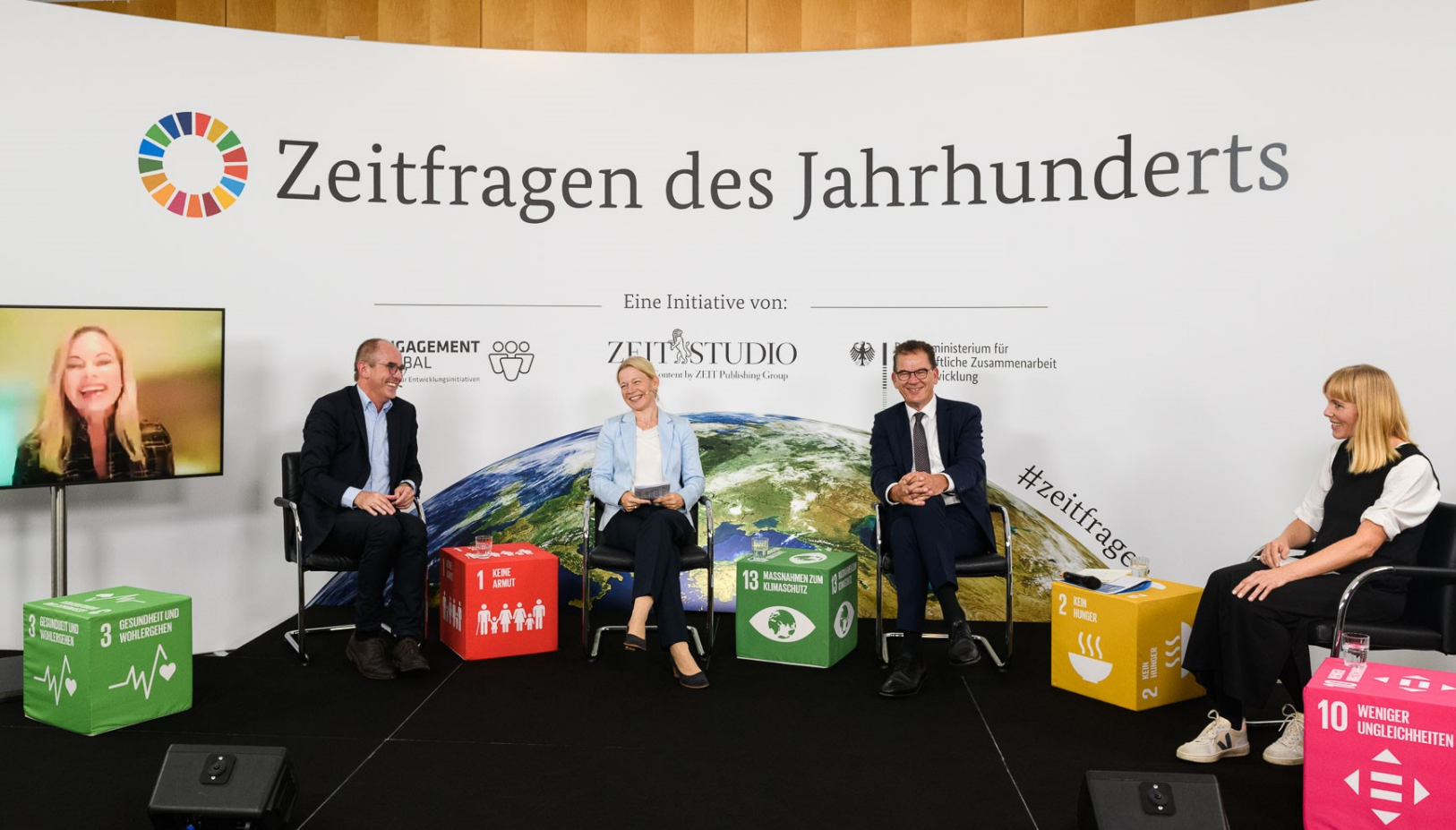
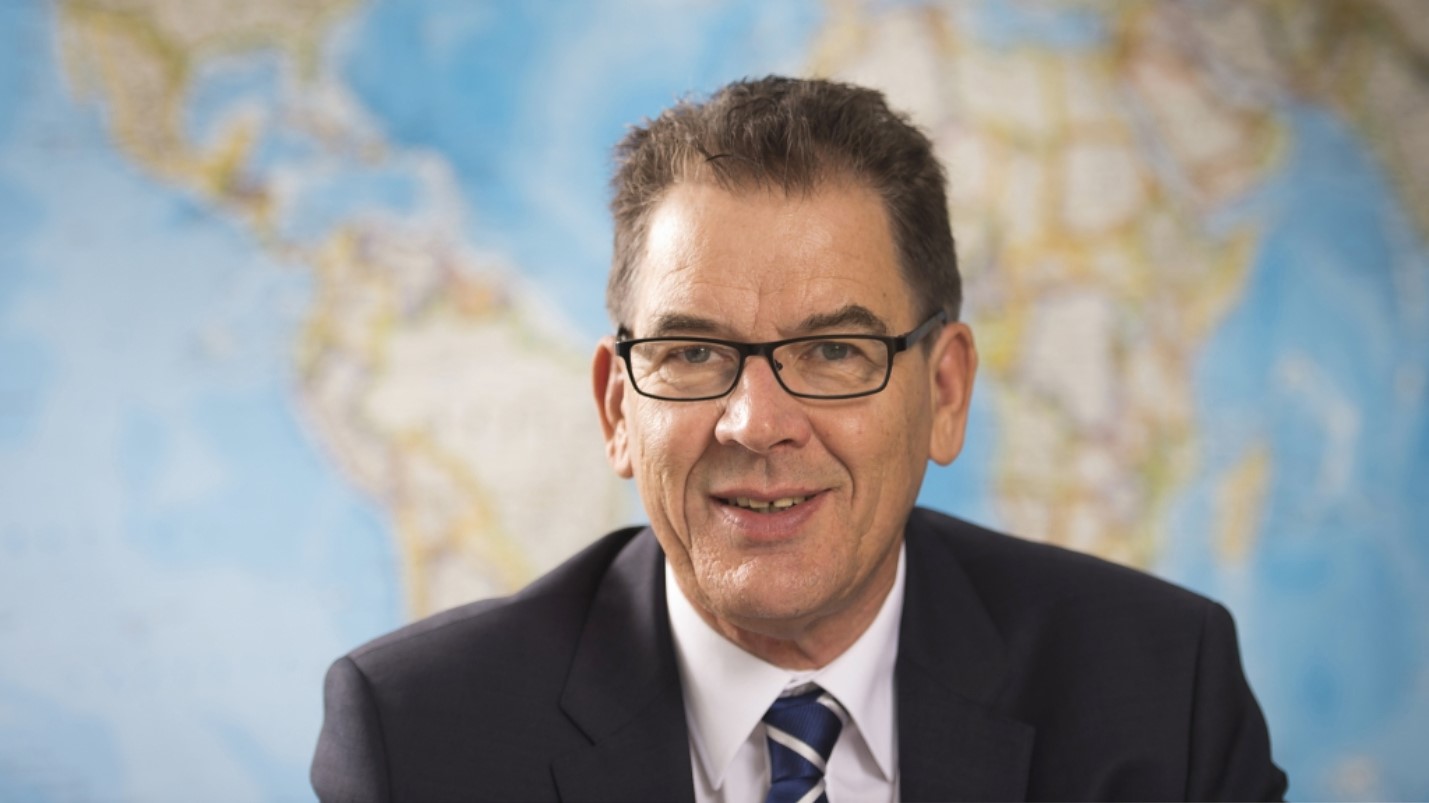
In the twelfth episode, Federal Minister for Economic Cooperation and Development Gerd Müller, Nina Ruge (journalist, TV presenter, and ambassador of the Alliance for Development and Climate), Prof. Dr. Estelle Herlyn (Scientific Director of the Competence Center for Sustainable Development at FOM Düsseldorf and Senior Researcher at FAW/n), and Christian Schneider (Managing Director of UNICEF Germany) discussed SDG 13: Climate Action.

Key themes included the issue of development—which, according to Prof. Herlyn, is often neglected—and the relationship between environmental protection and climate action. These two areas should go hand in hand, yet they are currently marked by conflicting goals. Population growth also plays a crucial role and must not be underestimated. “Climate protection is the key survival issue of the future,” emphasized Dr. Gerd Müller.
If we fail to achieve our climate goals, up to 500 million people will be severely affected, with children suffering the most from the consequences of climate change, as Christian Schneider pointed out. What does this mean for us personally? According to the panel of experts, change must begin with each individual. In this context, Nina Ruge advocates for membership in the Alliance for Development and Climate.

The FAW/n strongly supports Ambassador Nina Ruge and Senior Researcher Prof. Herlyn. At FAW/n, we explore how industrialized nations, together with developing and emerging economies, can work in unison at climate conferences toward carbon neutrality, identify the most promising and efficient solutions, and define the role of the private sector in this process.

You can find the full discussion and other episodes on different SDGs here.

Image source: Phil Dera
Federal Development Minister Müller to Become New Director General of UNIDO

Starting in January 2022, the current Federal Minister for Economic Cooperation and Development, Gerd Müller, will assume the position of Director General of the United Nations Industrial Development Organization (UNIDO). This marks the first time that a candidate from an industrialized country has taken on this role. The position had previously been held by Li Yong of China since 2013.

UNIDO promotes industrial development as a means of combating poverty, while also supporting globalization and environmental sustainability. It serves as an important partner for Germany in advancing global development and creating new jobs in developing countries.

Upon his nomination, Müller stated: “UNIDO can and should become the leading UN agency for implementing the 2030 Agenda, the Paris Agreement, the Convention on Biological Diversity, and the Beijing Declaration and Platform for Action on Gender Equality. The United Nations’ Sustainable Development Goals show us the path we must take. We all face enormous challenges – especially the developing countries. But we also have the opportunity to grow stronger together. We must act now, united for a better future!”

Dr. Gerd Müller is highly experienced in international development cooperation and economic development. Since 2013, he has served as Federal Minister for Economic Cooperation and Development. Through his participation in parliamentary assemblies of African, Caribbean, and Pacific states, he has gained extensive international experience. During his eight years as Parliamentary State Secretary, he was particularly committed to issues such as global food security and international agricultural development projects.

Among his most significant initiatives are the Green Button (Grüner Knopf), the Alliance for Development and Climate, and the Marshall Plan with Africa. FAW/n played a key role in the conceptualization and implementation of the latter two initiatives.

Further information:

Website of the Federal Ministry

Image source: © Michael Gottschalk/photothek.net

Federal Minister of Economic Cooperation and Development Dr. Gerd Müller Nominated as Candidate for UNIDO

On November 13, 2020, the Federal Minister of Economic Cooperation and Development Dr. Gerd Müller was nominated by the German Federal Cabinet as a candidate for the position of Director General of the United Nations Industrial Development Organization (UNIDO).

UNIDO promotes industrial development as a means of combating poverty, fostering globalization, and ensuring environmental sustainability. It is an important partner for Germany in promoting global development and creating new jobs in developing countries.

According to the German government, there are “other strong candidates for the election in November 2021.” However, no other candidates have yet been officially announced. So far, the position of Director General has always been held by men from developing or emerging countries. If elected, Dr. Gerd Müller would be the first European to assume this role.

Dr. Müller is highly familiar with international development cooperation and economic development. Since 2013, he has served as Federal Minister for Economic Cooperation and Development. Through his participation in parliamentary assemblies of African, Caribbean, and Pacific states, he has gained significant international experience. During his eight years as Parliamentary State Secretary, he placed particular emphasis on global food security and international agricultural development projects.

Among the most notable initiatives he launched are the Green Button (Grüner Knopf), the Alliance for Development and Climate, and the Marshall Plan with Africa. FAW/n played a key role in the conceptualization and implementation of the latter two initiatives.

Other major achievements of his tenure include the expansion of cooperation with Africa, the “One World – No Hunger” initiative, his commitment to international climate protection, and close collaboration with the private sector. During the COVID-19 pandemic, in addition to supporting immediate health responses, he also worked to preserve jobs in developing countries, as poorer nations and their populations have been hit hardest by the crisis — for them, the pandemic could result in a lost decade.

Further information

Website of the Federal Ministry for Economic Cooperation and Development (BMZ)

Website of UNIDO

Handelsblatt report

Image source: © Michael Gottschalk/photothek.net

Rethinking – A Question of Humanity’s Survival

The new book by the Federal Minister for Economic Cooperation and Development Dr. Gerd Müller

We know what needs to be done to combat hunger, inadequate healthcare, and climate change worldwide. Theoretically. But knowledge alone is not enough; we must open our eyes and recognize our responsibility.

In his latest book, Federal Minister Dr. Gerd Müller calls for courageous rethinking in a globalized world, where a new Europe–Africa pact and a renewed sense of global responsibility could make the world a bit more peaceful, just, and sustainable for future generations. It is a book that opens eyes without moralizing, yet reminds us of our responsibility in an interconnected world.

“Gerd Müller provides unique insights into the actual conditions at numerous critical flashpoints around the world. In his role overseeing international development cooperation for a globally prominent country like Germany, he is personally familiar with the realities across the globe like few other German politicians. He has visited almost all developing and emerging countries, in Africa and beyond. He has been present in all crisis regions of the past decade, witnessing firsthand the hotspots created by civil wars, famine, terrorism, climate change, displacement, organized crime, and the abuse of people, especially women and children.

Gerd Müller has absorbed a great deal and, in his new book, allows the reader to share in a journey through a world where beauty and horror exist side by side.”Prof. Dr. Dr. Dr. h.c. Franz Josef Radermacher

The book can be purchased online via the publisher’s website.

Image source: pixabay/Hermann

Second Meeting of the Supporters’ Circle of the Alliance for Development and Climate

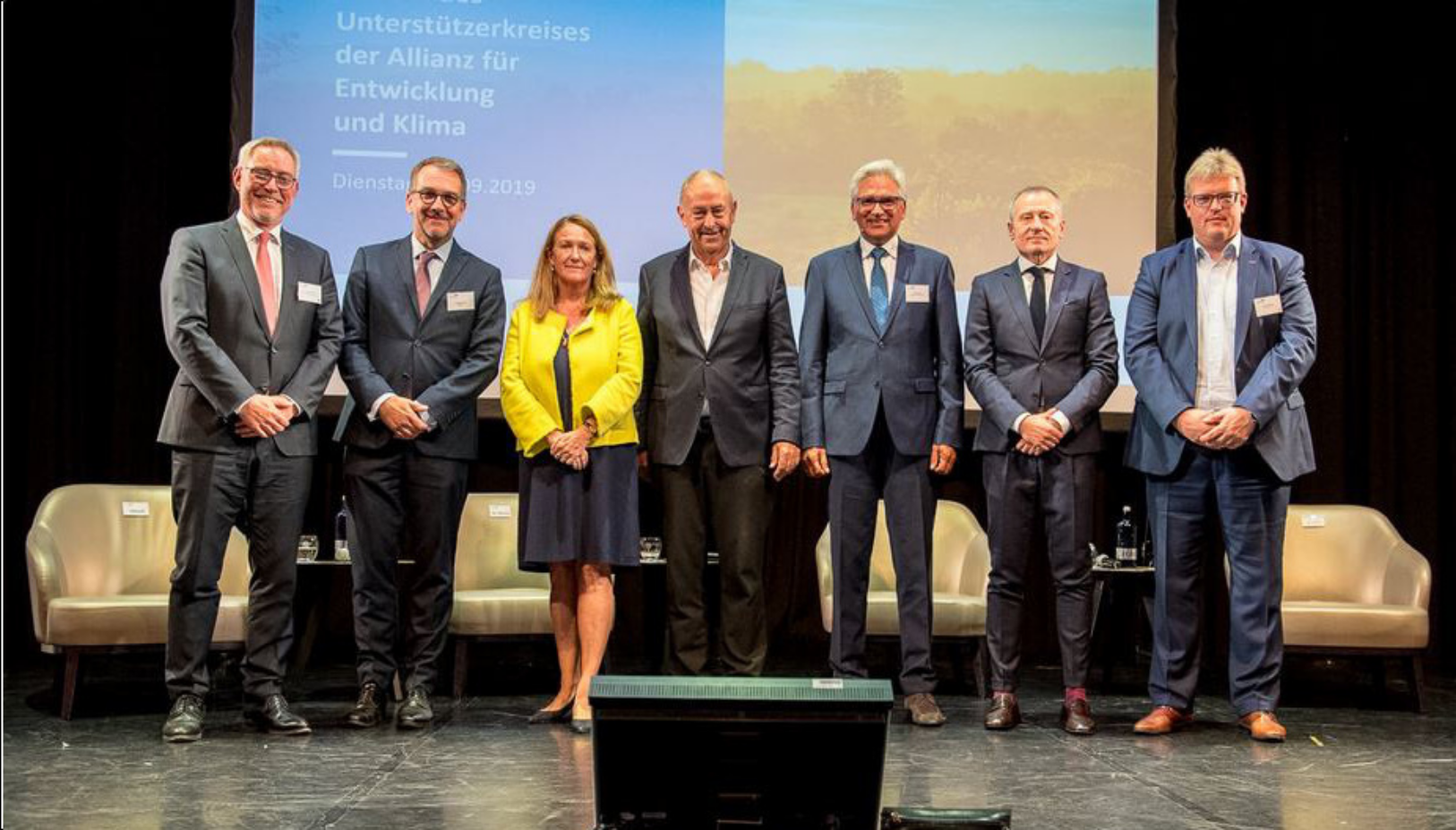
On September 17, the Supporters’ Circle of the Alliance for Development and Climate convened in Bonn. Around 200 supporters and interested participants discussed the potential of additional voluntary engagement by non-state actors in climate protection and development with Federal Minister Dr. Gerd Müller and other high-ranking guests. [Link to photo gallery and article].

At the sidelines of the meeting, Federal Minister Müller presented the Alliance’s initiatives and recommendations for international climate policy. The [YouTube video] shows the press conference, which also featured contributions from Prof. Radermacher.

Photos © GIZ/Aschoffotografie

More Forests, Less Climate Change

An Important Building Block of the Alliance for Development and Climate

At the official press conference held at the Federal Press Conference in Berlin, Federal Minister Dr. Gerd Müller, Plant-for-the-Planet, FAW/n, and the Senate of Economy Germany presented a study from ETH Zurich. The study demonstrates that large-scale global reforestation has the potential to reduce global warming by up to 1 degree Celsius.

Federal Press Conference on Reducing Global Warming through Forest Restoration, July 3, 2019

Reforestation and forest conservation are key project categories of the Alliance for Development and Climate, which was launched by the German Federal Ministry for Economic Cooperation and Development (BMZ), together with GIZ and FAW/n. Supporters of the Alliance contribute voluntarily to help preserve forest areas in developing countries and remove CO₂ from the atmosphere through reforestation. Projects that promote humus formation in agriculture, develop renewable energy sources, or expand the use of efficient cookstoves achieve the same effect. In addition, these projects generate enormous co-benefits for sustainable development and the United Nations’ Sustainable Development Goals (SDGs).

The fact that so much forest is still being lost, too little reforestation is taking place, and insufficient progress is being made in development is largely due to a lack of financial resources. Public funds alone are not enough to meet the challenges ahead. That is why the Alliance for Development and Climate brings together private-sector actors whose goal is to become climate neutral in the long term. Recently, Robert Bosch GmbH announced that it intends to operate climate-neutrally as of 2020. The company invests around one billion euros annually to achieve this goal, using high-quality climate protection and development projects in developing countries.

In July, Federal Minister Müller will travel to Brazil to discuss, among other things, the fastest measure against climate change — forest conservation — with the responsible ministers there.

Image source: pixabay/Bergadder