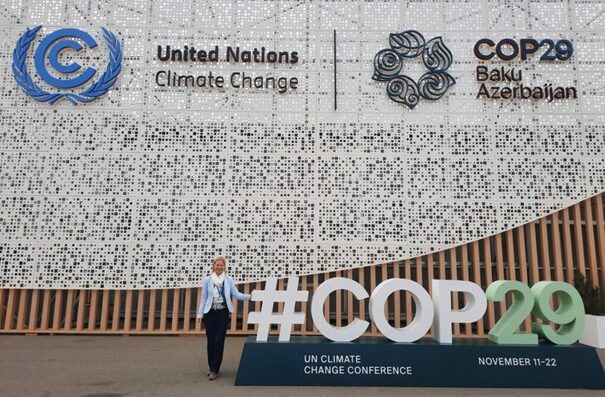
This year’s climate change conference in Baku primarily focused on international financing of climate-related issues. The key points of the final declaration include:
An increase in public financing of climate-related issues for developing countries from the current $100 billion USD per year to at least $300 billion USD per year by 2035,
A rise in funding from all sources, both public and private, to at least $1.3 trillion USD per year by 2035,
Standards and rules for international carbon markets (Article 6.4) that enable new financial flows to the Global South.
These are steps in the right direction to meet the legitimate expectations of the Global South AND create the prerequisites for successful climate action. The conference certainly contributes to greater realism regarding the necessity of international cooperation and financing. Even though many questions remain unanswered and developing countries would have preferred larger sums, there is hope that the coming weeks and months will bring further steps toward a viable overall concept for solving the climate challenge. With the GES book “ALL IN!”, a proposal exists for what this could look like
Here you can read the report on COP29 by Estelle Herlyn (GES), who attended the conference in Baku in person:
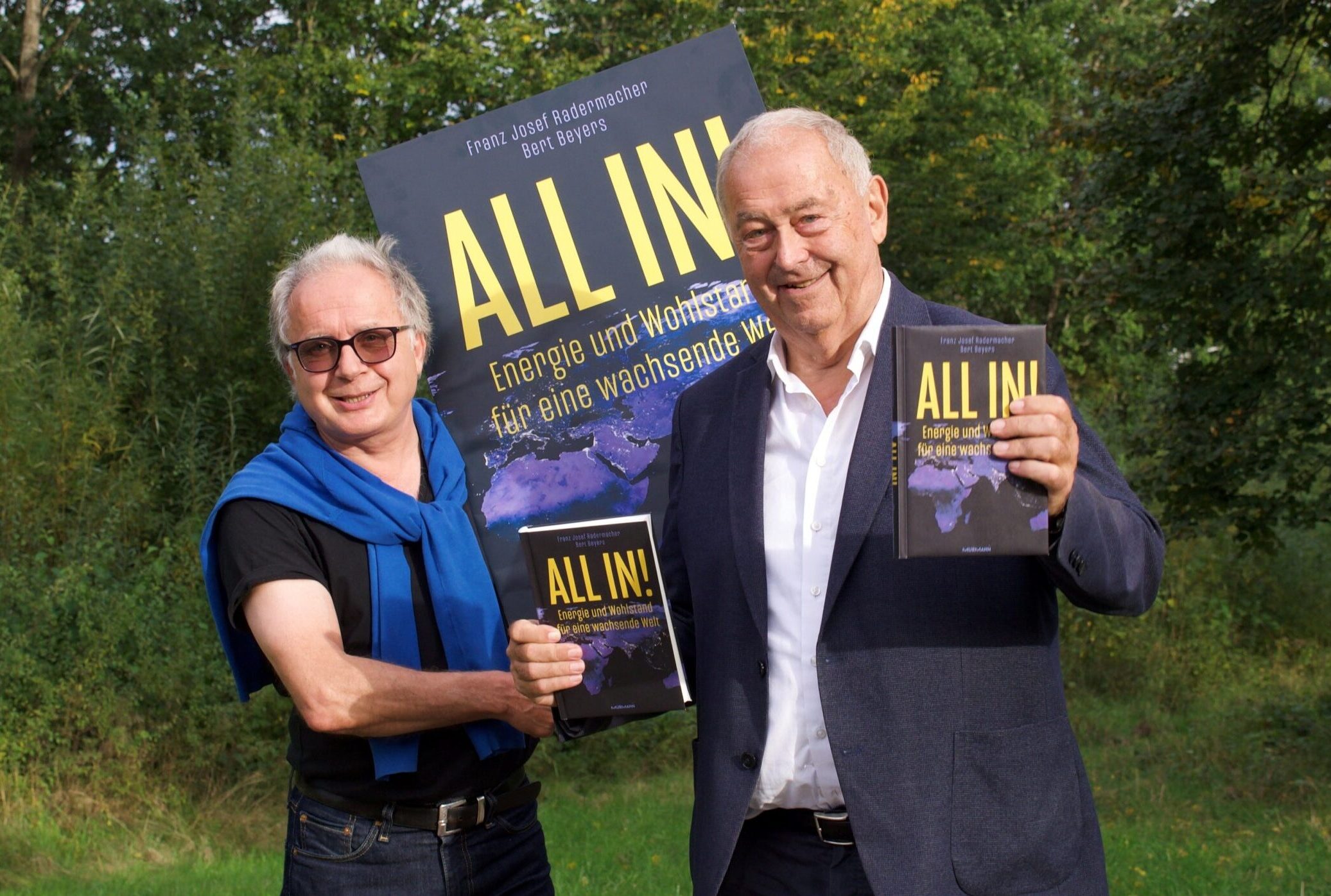
Just in time for the 2024 Frankfurt Book Fair (October 22, 2024), Murmann Verlag has published “ALL IN! Energy and Prosperity for a Growing World”.
ALL IN! – Energy and Prosperity for a Growing World by Franz Josef Radermacher and Bert Beyers – along with many collaborators – is a passionate appeal for a realistic and fair global energy transition. The authors criticize Germany’s focus on an “All-Electric” strategy and exclusively renewable energy as insufficient, unrealistic, and unaffordable. Given the rapidly growing global energy demand – especially in the Global South – they advocate for a technology-neutral approach, which includes fossil fuels with carbon capture as well as modern nuclear power.
The book emphasizes the need to support developing and emerging economies in achieving economic growth, even if this leads to higher emissions, in order to combat poverty. At the same time, industrialized nations must invest heavily in making climate-friendly technologies globally accessible. This is the only way to effectively combat climate change.
Radermacher and Beyers argue for pragmatism over ideology and global cooperation over national solo efforts. Their goal: prosperity for all while limiting global warming and preserving biodiversity. ALL IN! is a call for a course correction in energy policy – realistic, solidarity-driven, and future-oriented.
Key Arguments:
· ALL IN! – We must immediately start utilizing exclusively climate-neutral and safe energy sources: renewables, fossil fuels with carbon capture, and nuclear energy.
· ALL IN! – This requires a pragmatic and technology-neutral approach – in a symbiosis of technology and nature.
· ALL IN! – The climate challenge will not be decided in Germany, Europe, or even the U.S., but rather in China, India, and Africa. Climate nationalism is not the answer – and Germany’s “All Electric” approach is also a dead end.
The book can be ordered from Murmann Publishers (order here), from Thalia (order here), from Hugendubel (order here), or at your local bookstore of choice.
Image source: FAW/n & Global Energy Solutions
https://www.fawn-ulm.de/wp-content/uploads/2024/10/P1210383_2MB-scaled-e1746036167449.jpg13962073FAW/nhttps://www.fawn-ulm.de/wp-content/uploads/2017/10/Logo_oben-300x121.pngFAW/n2024-10-22 10:48:002025-10-16 11:03:04Book “ALL IN!” published
The Research Institute for Applied Knowledge Processing (FAW/n) in Ulm mourns the loss of Prof. Klaus Töpfer, one of the great global leaders in sustainability, who passed away on June 8, 2024, after a brief, severe illness. (*July 29, 1938 – June 8, 2024†)
As a politician, visionary thinker, brilliant strategist, and exemplary mediator, Klaus Töpfer will remain in the memory of many. Prof. Dr. Klaus Töpfer can truly be described as an exceptional personality. Those fortunate enough to have known him – whether as a federal minister or later as one of the highest-ranking UN directors – could witness firsthand his extraordinary foresight, his visionary ideas, and his commitment to collaboration even in the face of the most challenging issues. Professor Töpfer will be deeply missed as a role model.
We collaborated closely with Professor Töpfer for decades. We miss him greatly and will honor his memory with the highest respect.
https://www.fawn-ulm.de/wp-content/uploads/2021/12/candles-1.png9271626FAW/nhttps://www.fawn-ulm.de/wp-content/uploads/2017/10/Logo_oben-300x121.pngFAW/n2024-06-13 11:16:002025-10-16 11:19:38Remembering Prof. Klaus Töpfer
Michael Evertz cycled over 8,800 kilometers to reach the 2023 UN Climate Change Conference (COP28) in Dubai. The journey was grueling, with temperatures nearing 50°C at times. Starting in Berlin, the sustainability researcher and economist arrived in Dubai after 222 days and was able to participate in COP28.
On April 22, 2023 (Earth Day) Evertz launched his “Expedition Hope” at the Brandenburg Gate in Berlin. Prior to this, he had already engaged in close discussions with Prof. Franz Josef Radermacher from the Research Institute for Applied Knowledge Processing (FAW/n). From Berlin, he cycled through Cologne, Zugspitze, Istanbul, and the Middle East before reaching Dubai. The goal of his journey is to spread the message “Collaboration is the Mother of Surviving”. These words came from a conversation with an Ethiopian farmer during an earlier trip, where the farmer shared his experiences with climate change in Africa and its social consequences.
Throughout his journey, Evertz shared and discussed this message with people in numerous countries. For him, direct dialogue is essential – and his bicycle helps facilitate it: “From my many exploratory and research trips, I know that traveling with a fully loaded bike is still something extraordinary. It sparks curiosity and opens doors – to mayors, politicians, clergy, scientists, and even celebrities”. Evertz advocates for global, cross-cultural collaboration, a message emblazoned on the flag attached to his bike: “Stand up for the Planet. Start Collaboration”.
“Only if we share universal values and act together across cultures – with unity, cooperation, and mutual respect – can humanity survive at a high civilizational level. Only then can we protect nature, counter climate crises, wars, refugee disasters, suffering, hunger, and thirst, and resist the ruthless global competition and the belief in the law of the strongest. Because only “cooperation” gives life social meaning. Only through cooperation can we solve the destructive problems of modern life”.
This was the message Michael Evertz brought to COP28. There, he met with Prof. Radermacher, Prof. Herlyn, and Dr. Orthen, among others. Notably, conference president Dr. Sultan Ahmed Al-Jaber – an avid cyclist himself – took time to speak with Evertz, promising to “take care of the planet”. He also invited Evertz for a joint bike ride in Abu Dhabi to continue their dialogue.
With COP28 concluded, Evertz’s “Expedition Hope” is far from over. He plans to cycle across Africa, aiming for the Cape of Good Hope in South Africa. From there, he hopes to board a ship to Brazil, ride into the Amazon rainforest, and attend COP30 in Belém, Brasilien. However, he still needs financial support to continue his mission.
Evertz documents his encounters and “Stories of Hope” on social media. He also intends to give talks at schools and companies, inspiring others to take action under his motto: “Stand up for the Planet. Start Collaboration”.
We wish Michael Evertz continued success in his endeavors. We will support him and follow his journey – and his cross-cultural exchanges – with great interest.
For more on Michael Evertz and “Expedition Hope”, including photos, visit www.expedition-hope.earth or his Instagram @expedition_hope_earth.
https://www.fawn-ulm.de/wp-content/uploads/2024/01/231130-Evertz_Expedition_Hope-01.jpg7801386FAW/nhttps://www.fawn-ulm.de/wp-content/uploads/2017/10/Logo_oben-300x121.pngFAW/n2024-01-22 11:19:002025-10-16 11:44:32Michael Evertz and COP28: An Inspiring Message
Cookie-Zustimmung verwalten
We use a few cookies to give you the best possible online experience.
Funktional
Always active
Die technische Speicherung oder der Zugang ist unbedingt erforderlich für den rechtmäßigen Zweck, die Nutzung eines bestimmten Dienstes zu ermöglichen, der vom Teilnehmer oder Nutzer ausdrücklich gewünscht wird, oder für den alleinigen Zweck, die Übertragung einer Nachricht über ein elektronisches Kommunikationsnetz durchzuführen.
Vorlieben
Die technische Speicherung oder der Zugriff ist für den rechtmäßigen Zweck der Speicherung von Präferenzen erforderlich, die nicht vom Abonnenten oder Benutzer angefordert wurden.
Statistiken
Die technische Speicherung oder der Zugriff, der ausschließlich zu statistischen Zwecken erfolgt.Die technische Speicherung oder der Zugriff, der ausschließlich zu anonymen statistischen Zwecken verwendet wird. Ohne eine Vorladung, die freiwillige Zustimmung deines Internetdienstanbieters oder zusätzliche Aufzeichnungen von Dritten können die zu diesem Zweck gespeicherten oder abgerufenen Informationen allein in der Regel nicht dazu verwendet werden, dich zu identifizieren.
Marketing
Die technische Speicherung oder der Zugriff ist erforderlich, um Nutzerprofile zu erstellen, um Werbung zu versenden oder um den Nutzer auf einer Website oder über mehrere Websites hinweg zu ähnlichen Marketingzwecken zu verfolgen.