End-of-Year Message

Global challenges are growing. The United States is destabilizing the international order and breaking treaties, while China seeks to expand its influence in the South China Sea. Brexit, financial instability in Italy, and populist trends across many EU countries make smart policymaking increasingly difficult. As a result, the outlook for sustainable development is worrying.

Warnings from the IPCC and the Club of Rome, which recently celebrated its 50th anniversary, are clear: urgent action is needed. In response, FAW/n has been working with the Federal Ministry for Economic Cooperation and Development (BMZ) to establish the Alliance for Development and Climate, promoting non-governmental engagement in development and international climate protection. This initiative has the potential to drive significant change in climate policy, the 2030 Agenda, and global population trends – potentially a quantum leap forward. At the same time, we are collaborating with the Senate of Economy on a study to be released ahead of the European elections, presenting a vision for a stronger, more united Europe.

Through these and other initiatives, FAW/n continues to contribute to shaping a sustainable future, together with the Club of Rome, the Senate of Economy, the BMZ, and many other partners – including the University Days on Eco-Social Market Economy and Sustainability.

We are grateful for the opportunity to work closely with our partners and sincerely thank everyone for their broad support throughout the year.

Image source: pixabay/Free-Photos

Lecture: Tracking Megatrends

Under the title “Tracking Megatrends” Prof. Franz Josef Radermacher gave a lecture in Langenau on November 15, 2018. The SWP reports the following:

Globalization, digitalization, sustainability, world population growth, urbanization, and the role of women beyond the household – according to the Ulm-based professor, these are the forces shaping our world.

On Thursday evening, 180 visitors attended the lecture at the Pfleghof in Langenau to hear the 68-year-old head of the Research Institute for Applied Knowledge Processing speak live. Harald Ostermeir from the organizing Trade and Business Association (GHV) described him as “one of the most distinguished speakers in the German-speaking world”.

For around an hour and a half, Radermacher offered a lively yet sobering lecture titled “Germany as a Business Location Amid Powerful Megatrends.” He warned, “Something truly alarming is happening that could affect us all”. He highlighted the explosive growth of the world population – projected to reach ten billion by 2050, especially in Africa. While many people there face food insecurity, they have access to smartphones and the internet, opening up “a world full of possibilities”. Many, he predicted, will seek opportunities in Europe.

The full SWP article is available here.

Photo (c) Thomas Klink

Book Review: Der Milliarden-Joker (The Billionaire Joker)

A Master Plan to Save the World – but with a Catch

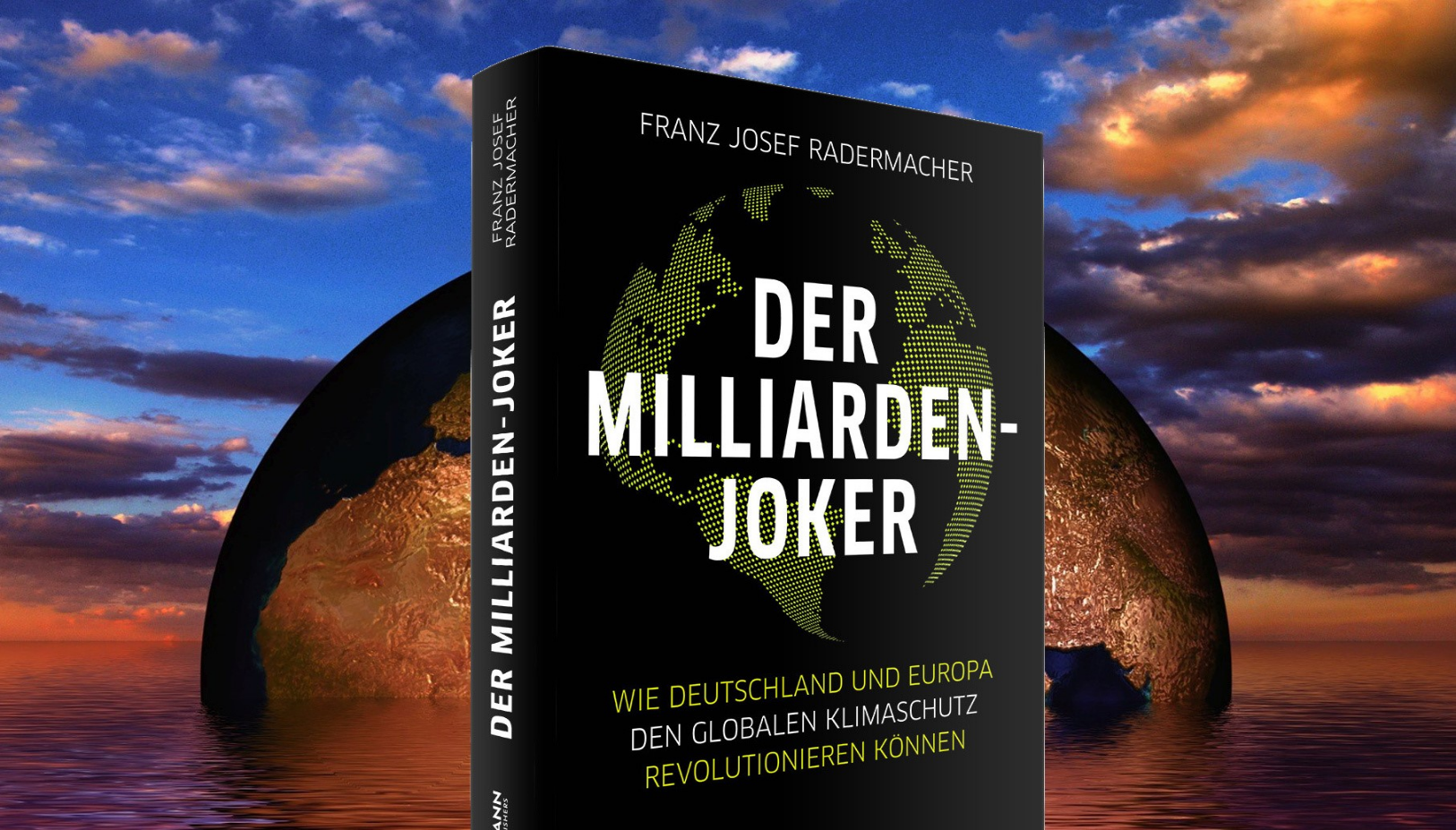
Handelsblatt reviews Prof. Franz Josef Radermacher’s new book, Der Milliarden-Joker, under this striking headline.

Buch: Der Milliarden-Joker

“Climate change IS the defining challenge of our time – and we are on the verge of losing the battle. In ‘Der Milliarden-Joker,’ mathematician, economist, and computer science professor Franz Josef Radermacher proposes a way to tackle global warming – yet leaves the reader at the end filled with frustration and despair…”

You can read the full review in Handelsblatt here.

The book is available from Murmann Verlag:

New Report by the Intergovernmental Panel on Climate Change (IPCC)

“The latest report by the Intergovernmental Panel on Climate Change (IPCC) sends a clear message: Climate change is increasingly becoming a question of humanity’s survival. If we do not act decisively now, millions of people will be forced to leave their homes. To slow down climate change and mitigate its impacts, the German Federal Government provided €3.65 billion last year. Of that, more than €3 billion was made available by the Federal Ministry for Economic Cooperation and Development (BMZ) alone to support climate protection and adaptation projects in developing countries.

But that is far too little. We would need to invest at least ten times that amount to promote climate-neutral development. This requires the large-scale generation of negative emissions – for example, through reforestation and humus-rich agriculture in semi-arid regions – as well as the promotion of renewable energies, energy efficiency, and synthetic fuels in non-industrialized countries.

Unfortunately, these international approaches have so far received too little attention in the German debate. The focus is mainly on the situation in Germany and on local activities, even though these alone cannot solve the climate problem. Even for the planned national measures, the available funds are insufficient. There is certainly no adequate financing for a more extensive international climate policy. Nevertheless, this has not stopped people from interpreting the IPCC report as if it also emphasized a primarily national focus.

Against this background, we are pleased that Minister Müller and the BMZ will launch a multi-stakeholder initiative called the Alliance for Development and Climate in the coming months. The goal is to engage non-state actors – especially companies and wealthy individuals – in making voluntary contributions to international climate protection and the implementation of the 2030 Agenda through high-quality voluntary CO₂ offsetting measures in non-industrialized countries.

Mobilizing non-state actors is currently one of the greatest opportunities we have to perhaps still achieve the 2°C target.”

Plant-for-the-Planet, the Global Marshall Plan Initiative, the Senate of Economy, the Foundation Responsibility, and many other actors pursue a different approach: international activities, massive reforestation, negative emissions, and emphasizing the special responsibility of the top emitters – those are wealthy individuals with a pronounced lifestyle and several hundred tons of individual CO₂ emissions per year.

Links:

Image source: pixabay/SD-Pictures

New Publications from FAW/n

All the points addressed in the special report of the Intergovernmental Panel on Climate Change (IPCC), “Global Warming of 1.5°C”, can be found in the new book “The Billionaire Joker”, published by Murmann Verlag, by the institute’s director. It can be read as a response to the latest global climate report.

A book full of surprising insights, information, and findings. Anyone who wants to participate knowledgeably in the current situation should definitely read this book.

Climate. Positive. Now.
Global warming is progressing relentlessly. The crucial question: Can the international community still prevent a climate catastrophe?
Franz Josef Radermacher is cautiously optimistic. His proposal is brilliantly simple and rigorously calculated: Non-state actors in Germany and Europe voluntarily and at their own expense offset their greenhouse gas emissions – beyond all legal requirements and other individual measures – through high-quality CO2 compensation projects in non-industrialized countries. At the same time, substantial co-benefits regarding the UN Sustainable Development Goals are achieved. Key elements of implementation include reforestation, humus formation, wetland restoration, use of renewable energies, and climate-neutral synthetic fuels.

Overcoming conflicts of objectives between ecology, economy, and social issues. For an ecologically and socially oriented economy and the valorization of degraded nature.

Der Milliarden-Joker.

Franz Josef Radermacher is one of the country’s leading economists and systems scientists. On the international stage, he advises governments, companies, associations, and NGOs.

Further Information

Books, that were also recently published on the same topic:

Climate Neutrality – Hessen 5 Years Ahead

Martin J. Worms, Franz Josef Radermacher

Springer Fachmedien Wiesbaden, 01.10.2018 – 308 pages

The climate issue is gaining increasing importance. Global CO2 emissions continue to rise. In this context, the state of Hessen has taken an important step as a mid-level political entity, which is beginning to exert significant leverage. Hessen is the first German federal state to declare its intention to make its own administration climate-neutral by 2030. The Hessian climate-neutrality project is embedded in the state’s overarching sustainability strategy and is a project of outstanding significance within this strategy.

Excerpt from the Foreword

The international community has committed to the 2°C target in climate protection. In 2015, in Paris, this target was even tightened to “well below 2°C.” This goal requires that average global temperatures rise in the future by significantly less than 2°C compared to pre-industrial times. According to scientific analyses by the Intergovernmental Panel on Climate Change (IPCC), there is still a good chance under this condition to manage climate changes without catastrophic consequences for humanity. According to the 1992 UN Climate Convention in Rio de Janeiro and the 2015 Paris Agreement, this involves jointly – but with shared responsibility among the states – controlling the risks of uncontrolled atmospheric change.

In this context, the state of Hessen decided in 2009 to achieve climate neutrality for its administration by 2030, going far beyond existing legal obligations. The state has systematically pursued this goal within its sustainability strategy, in connection with other activities, thereby setting an example and achieving strong influence. This mainly applies to its properties but also to employee business travel, and the state achieves much more through interactions with numerous actors in Hessen at all levels.

This volume presents the spectrum of climate-related activities achieved in Hessen, which is of particular interest to us as editors, documents the accomplishments, and places them in a global context. Who would have thought eight years ago that so much could be achieved in such a short time – or even five years ago, when the first edition of the now revised and newly published book “Climate Neutrality – Hessen Leads the Way” came out?