Prof. Radermacher is far from satisfied with current climate policies, as he explains in his interview with ISOCELLER. “What we are witnessing is a ‘panic concert,’ where inadequate methods are being used to solve a problem that is 50 years old,” he emphasizes. According to him, the reason is that climate issues – like the situation in Ukraine or the pandemic – are often politicized to win votes, but no real solutions follow.
Germany and Austria are too small to make a significant impact at a national level. Yet funding for climate protection is expected to remain within the country, which leads to measures that are very costly but ultimately ineffective. Added to this, population growth in Asia and Africa is substantial, and “all these people want to live, and they need electricity, food, and water.”
Once again, Prof. Radermacher calls on decision-makers to pursue international solutions, such as Carbon Capture for storing and using CO₂, and e-fuels, i.e., synthetic fuels produced from water and carbon dioxide. The magazine ISOCELLER explains in detail what these terms involve.
https://www.fawn-ulm.de/wp-content/uploads/2022/07/sustainability.png9271626FAW/nhttps://www.fawn-ulm.de/wp-content/uploads/2017/10/Logo_oben-300x121.pngFAW/n2022-06-10 13:05:002025-10-17 13:11:18“We Must Ensure Resources for Everyone!”
The new book by the Federal Minister for Economic Cooperation and Development Dr. Gerd Müller
We know what needs to be done to combat hunger, inadequate healthcare, and climate change worldwide. Theoretically. But knowledge alone is not enough; we must open our eyes and recognize our responsibility.
In his latest book, Federal Minister Dr. Gerd Müller calls for courageous rethinking in a globalized world, where a new Europe–Africa pact and a renewed sense of global responsibility could make the world a bit more peaceful, just, and sustainable for future generations. It is a book that opens eyes without moralizing, yet reminds us of our responsibility in an interconnected world.
“Gerd Müller provides unique insights into the actual conditions at numerous critical flashpoints around the world. In his role overseeing international development cooperation for a globally prominent country like Germany, he is personally familiar with the realities across the globe like few other German politicians. He has visited almost all developing and emerging countries, in Africa and beyond. He has been present in all crisis regions of the past decade, witnessing firsthand the hotspots created by civil wars, famine, terrorism, climate change, displacement, organized crime, and the abuse of people, especially women and children.
Gerd Müller has absorbed a great deal and, in his new book, allows the reader to share in a journey through a world where beauty and horror exist side by side.” – Prof. Dr. Dr. Dr. h.c. Franz Josef Radermacher
https://www.fawn-ulm.de/wp-content/uploads/2021/07/book-1.png9271626FAW/nhttps://www.fawn-ulm.de/wp-content/uploads/2017/10/Logo_oben-300x121.pngFAW/n2020-05-19 15:17:002025-10-23 15:24:24Rethinking – A Question of Humanity’s Survival
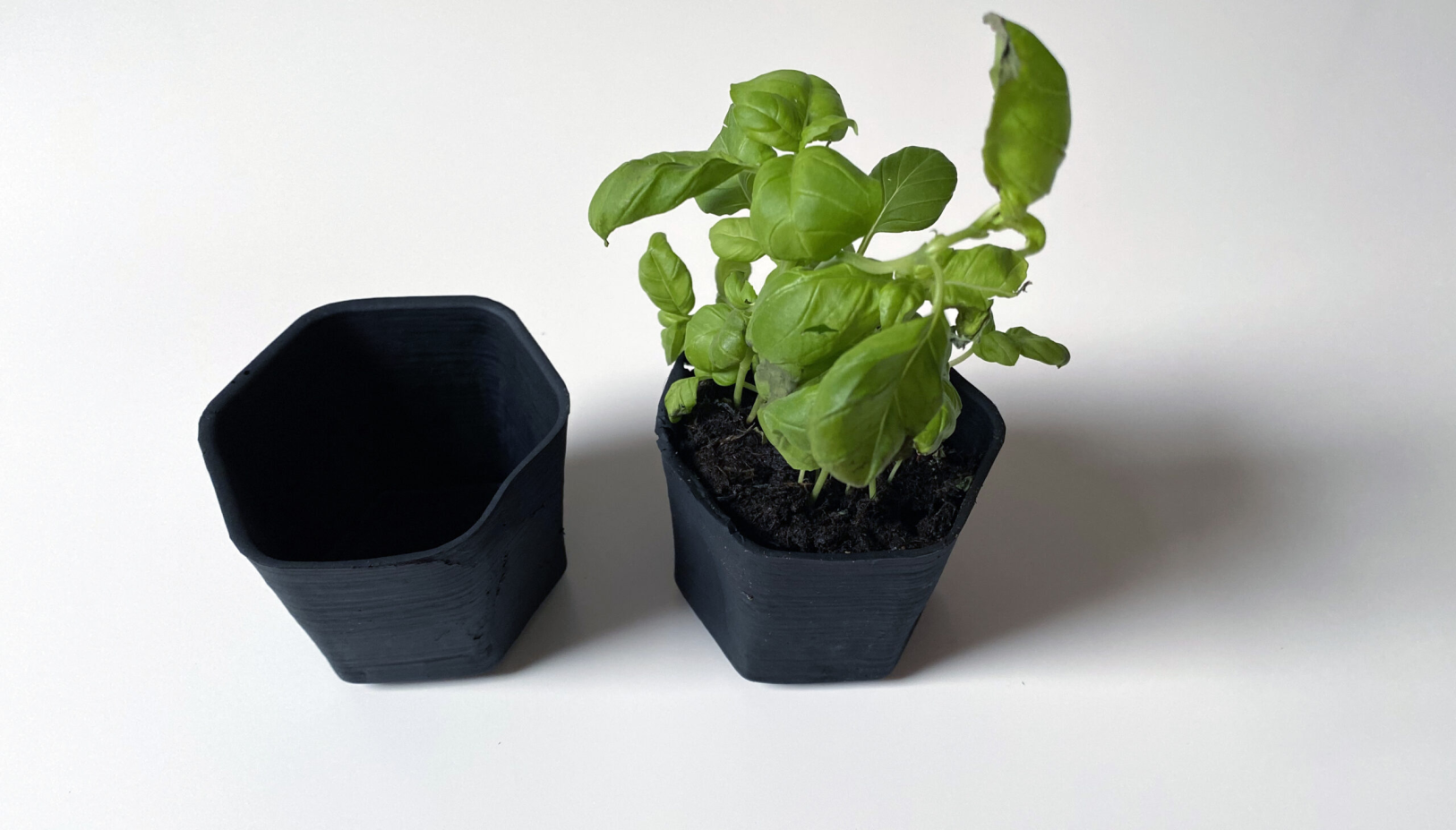
The use of biochar for the active reduction of greenhouse gases is at the heart of carbonauten GmbH’s work. Since its founding in 2017, this start-up has been developing innovative and sustainable products based on biochar, produced through the pyrolysis (carbonization) of biomass. According to carbonauten, in December 2019, under the brand name carbonauten OCM – Organic Carbon Materials, they introduced a conventionally injection-molded bowl made of biochar: “This patented material family could replace many petroleum-based plastics and building materials in the future. After use, products made from carbonauten OCM are either recycled or shredded and incorporated into the soil“. Incorporating biochar into soil acts as a CO₂-storing super fertilizer. Studies on Terra Preta – the fertile black soil created through human activity in South America – confirm this effect. Biochar therefore plays a key role in combating climate change by enabling negative emissions: plants absorb CO₂ during growth and convert it into biomass. Excess biomass (e.g., plant residues, cocoa or coconut shells) is converted into biochar through pyrolysis and added to the soil, effectively storing CO₂ underground.
Additionally, soil fertility improves because microorganisms can build humus more efficiently with the help of biochar. On degraded soils, biochar can help restore agricultural productivity – representing a major opportunity for promoting sustainable development, especially in non-industrialized countries.
At present, carbonauten is conducting a test with a German automobile manufacturer in which 30% of the plastic polypropylene (PP) is replaced by the company’s biochar. The product’s impact on climate change, measured as its Greenhouse Warming Potential (GWP), is 2.67 kg CO₂ equivalent per kilogram of conventional PP. With 30% biochar, this value drops by over 3 kg CO₂ – to –0.47 kg CO₂!
Further positive side effects include the natural black coloration of the material, eliminating the need for conventional industrial carbon black, and the renewable thermal energy generated continuously (24/7) in significant quantities during biochar production.
About carbonauten GmbH
carbonauten GmbH was founded in August 2017 by Torsten Becker and Christoph Hiemer in Giengen an der Brenz, Germany. The company’s goal is the active reduction and permanent storage of greenhouse gases. Woody biomass residues are carbonized through pyrolysis into biochar, while the surplus renewable energy generated is used as electricity or heat. From these biochars, carbonauten produces materials for the forestry and agricultural sectors, as well as the food, packaging, technical, and construction industries, in addition to architecture and design. In the coming years, the company plans to establish dozens of decentralized, highly efficient production sites worldwide, capable of producing hundreds of thousands of tons of specified biochar annually.
https://www.fawn-ulm.de/wp-content/uploads/2021/07/Pflanzentopf_Basilikum.png9271626FAW/nhttps://www.fawn-ulm.de/wp-content/uploads/2017/10/Logo_oben-300x121.pngFAW/n2020-03-06 16:26:002025-10-23 16:32:09Biomaterials Against Climate Change
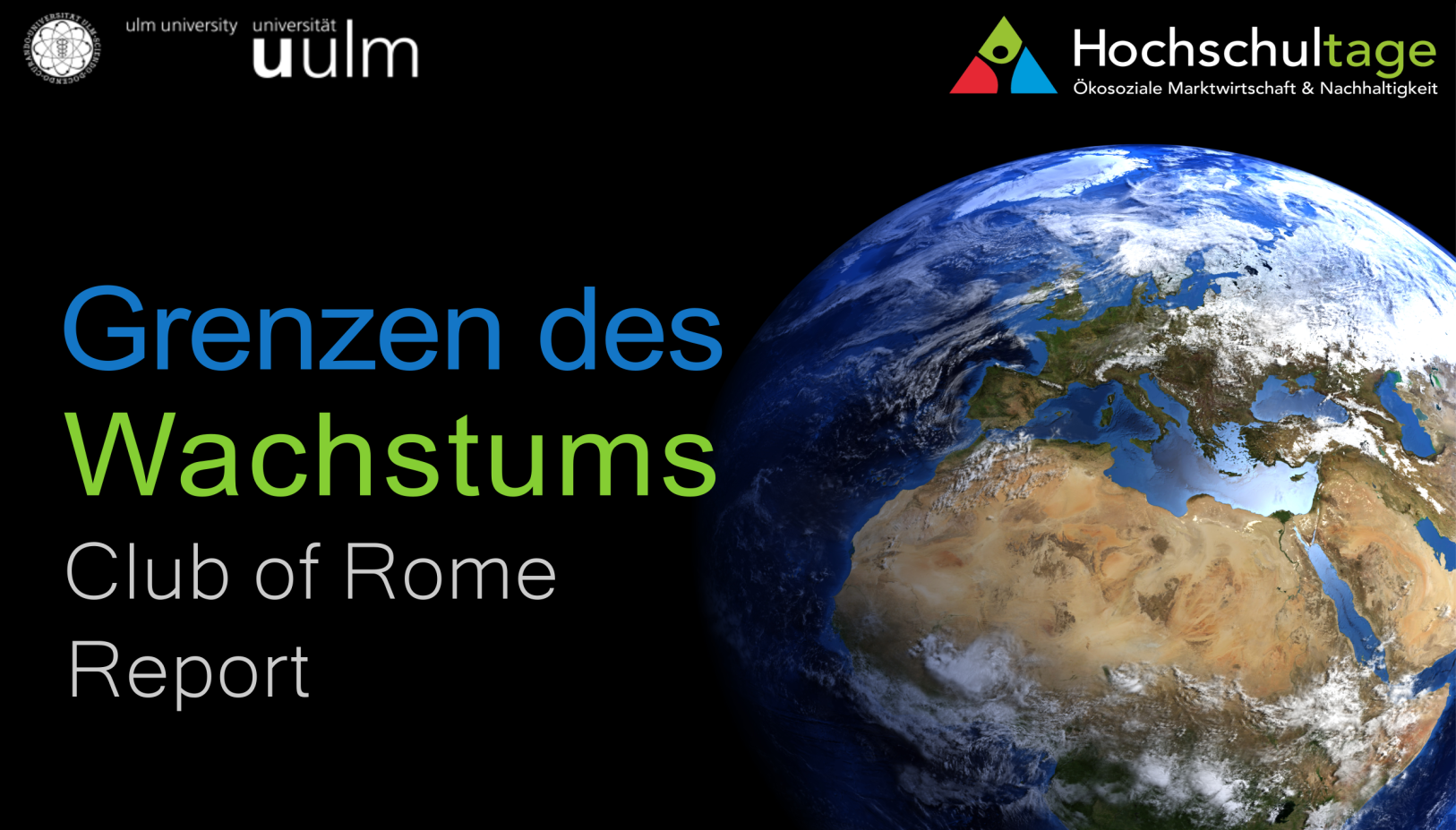
The question of the limits to growth, as posed by the Club of Rome back in 1972, remains as relevant today as ever. During the University Days on Ecological-Social Market Economy and Sustainability on Friday, May 24, renowned U.S. economist Professor Dennis Meadows once again assessed the situation. Meadows led the research team that produced the world-famous Club of Rome report and, in his lecture, presented updated scenarios addressing the current state of the world’s resource situation. Around 350 students and interested attendees participated in the event at the University of Ulm. You can find the presentation slides available for download here.
Professor Franz Josef Radermacher, Director of FAW/n and member of the Club of Rome, introduced the highly topical subject, and University President Professor Michael Weber delivered a welcoming address. The session was moderated by Tobias Orthen.
The scenarios described by Meadows range from a sustainable world to collapse. So where do we stand in 2019?
According to Meadows, the world is currently following the “Standard Scenario” outlined in the 1972 report – global population continues to grow, resource consumption keeps rising, and humanity is heading toward ecological collapse. The visible “symptoms” include climate change, water scarcity, and loss of biodiversity.
Welcoming – Prof. Michael Weber
Dennis Meadows | Club of Rome | Introduction – Prof. Franz Josef Radermacher
Keynote – Prof. Dennis Meadows
Overview of the Questions Asked
The Secret of the Lion Man – Presentation of the Gift
Humanity now faces two choices: either we steer our civilization toward sustainability, or these very symptoms will bring growth to an end.
But how close is the world we know to collapse? In his lecture, “Evaluating the Limits to Growth: Projections after 45 Years,” Professor Meadows did not spare his audience from uncomfortable truths.
The University Days on Ecological-Social Market Economy and Sustainability have been organized since 2010 by the Research Institute for Applied Knowledge Processing/n (FAW/n), the University of Ulm, and other partners including Club of Rome Germany and the Global Marshall Plan Initiative in the German-speaking world.
Fittingly for the occasion, Dennis L. Meadows was awarded the German Culture Prize 2019 in the Allerheiligen-Hofkirche of the Residenz in Munich earlier that morning. The ceremony was under the patronage of Prime Minister Dr. Markus Söder. The laudatory speech was delivered by Prof. Dr. Dr. Dr. h.c. Franz Josef Radermacher, member of the Club of Rome.
The speeches by Prof. Radermacher and Dennis L. Meadows can be accessed via the following links:
https://www.fawn-ulm.de/wp-content/uploads/2021/07/Plakat_Hochschultage.png9271626FAW/nhttps://www.fawn-ulm.de/wp-content/uploads/2017/10/Logo_oben-300x121.pngFAW/n2019-05-24 15:20:002025-10-30 16:28:27Dennis Meadows in Ulm and the Presentation of the German Culture Award in Munich
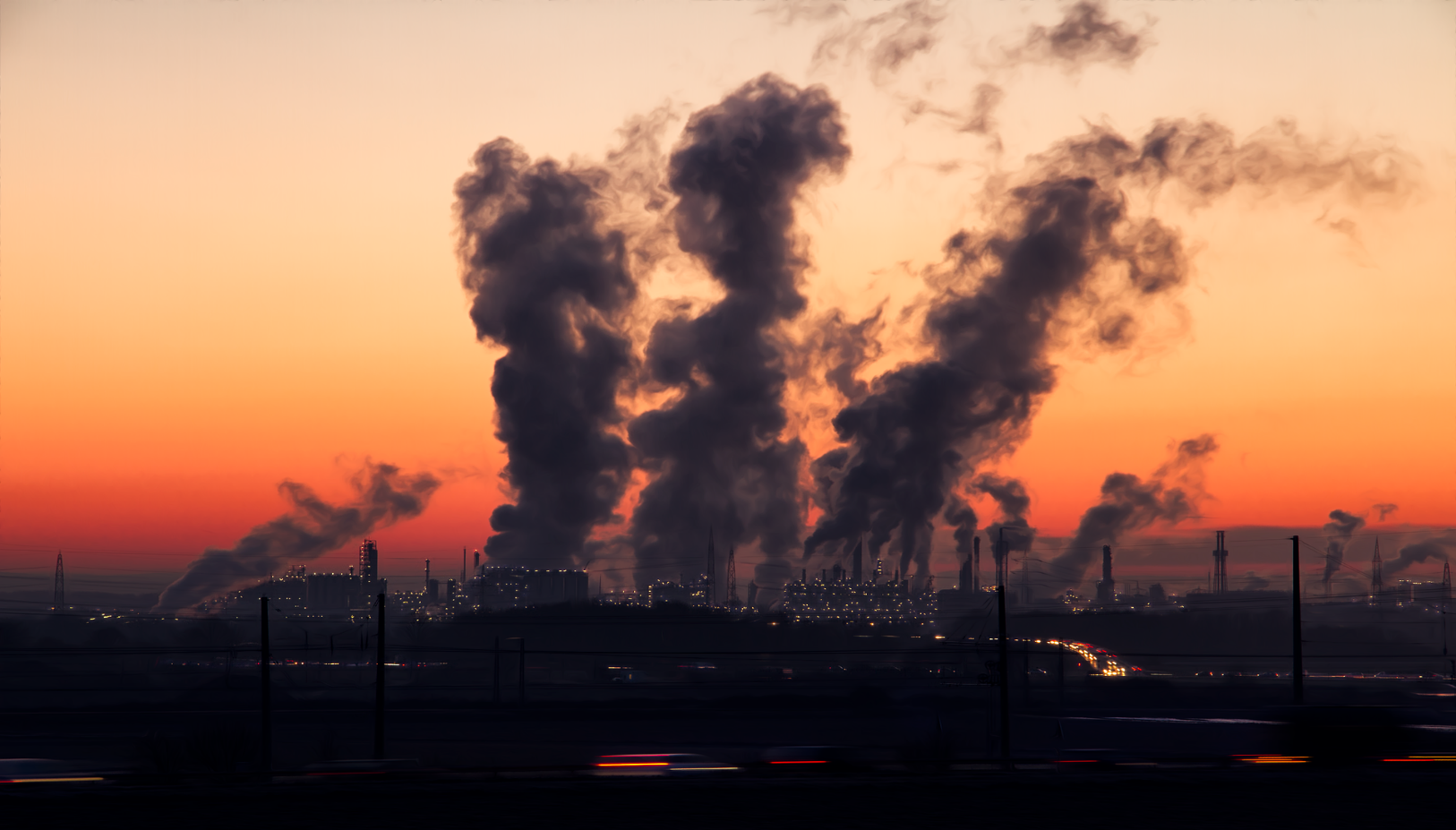
“The latest report by the Intergovernmental Panel on Climate Change (IPCC) sends a clear message: Climate change is increasingly becoming a question of humanity’s survival. If we do not act decisively now, millions of people will be forced to leave their homes. To slow down climate change and mitigate its impacts, the German Federal Government provided €3.65 billion last year. Of that, more than €3 billion was made available by the Federal Ministry for Economic Cooperation and Development (BMZ) alone to support climate protection and adaptation projects in developing countries.
But that is far too little. We would need to invest at least ten times that amount to promote climate-neutral development. This requires the large-scale generation of negative emissions – for example, through reforestation and humus-rich agriculture in semi-arid regions – as well as the promotion of renewable energies, energy efficiency, and synthetic fuels in non-industrialized countries.
Unfortunately, these international approaches have so far received too little attention in the German debate. The focus is mainly on the situation in Germany and on local activities, even though these alone cannot solve the climate problem. Even for the planned national measures, the available funds are insufficient. There is certainly no adequate financing for a more extensive international climate policy. Nevertheless, this has not stopped people from interpreting the IPCC report as if it also emphasized a primarily national focus.
Against this background, we are pleased that Minister Müller and the BMZ will launch a multi-stakeholder initiative called the Alliance for Development and Climate in the coming months. The goal is to engage non-state actors – especially companies and wealthy individuals – in making voluntary contributions to international climate protection and the implementation of the 2030 Agenda through high-quality voluntary CO₂ offsetting measures in non-industrialized countries.
Mobilizing non-state actors is currently one of the greatest opportunities we have to perhaps still achieve the 2°C target.”
Plant-for-the-Planet, the Global Marshall Plan Initiative, the Senate of Economy, the Foundation Responsibility, and many other actors pursue a different approach: international activities, massive reforestation, negative emissions, and emphasizing the special responsibility of the top emitters – those are wealthy individuals with a pronounced lifestyle and several hundred tons of individual CO₂ emissions per year.
https://www.fawn-ulm.de/wp-content/uploads/2021/07/industry.png9271626FAW/nhttps://www.fawn-ulm.de/wp-content/uploads/2017/10/Logo_oben-300x121.pngFAW/n2018-10-19 10:20:002025-10-31 13:31:35New Report by the Intergovernmental Panel on Climate Change (IPCC)
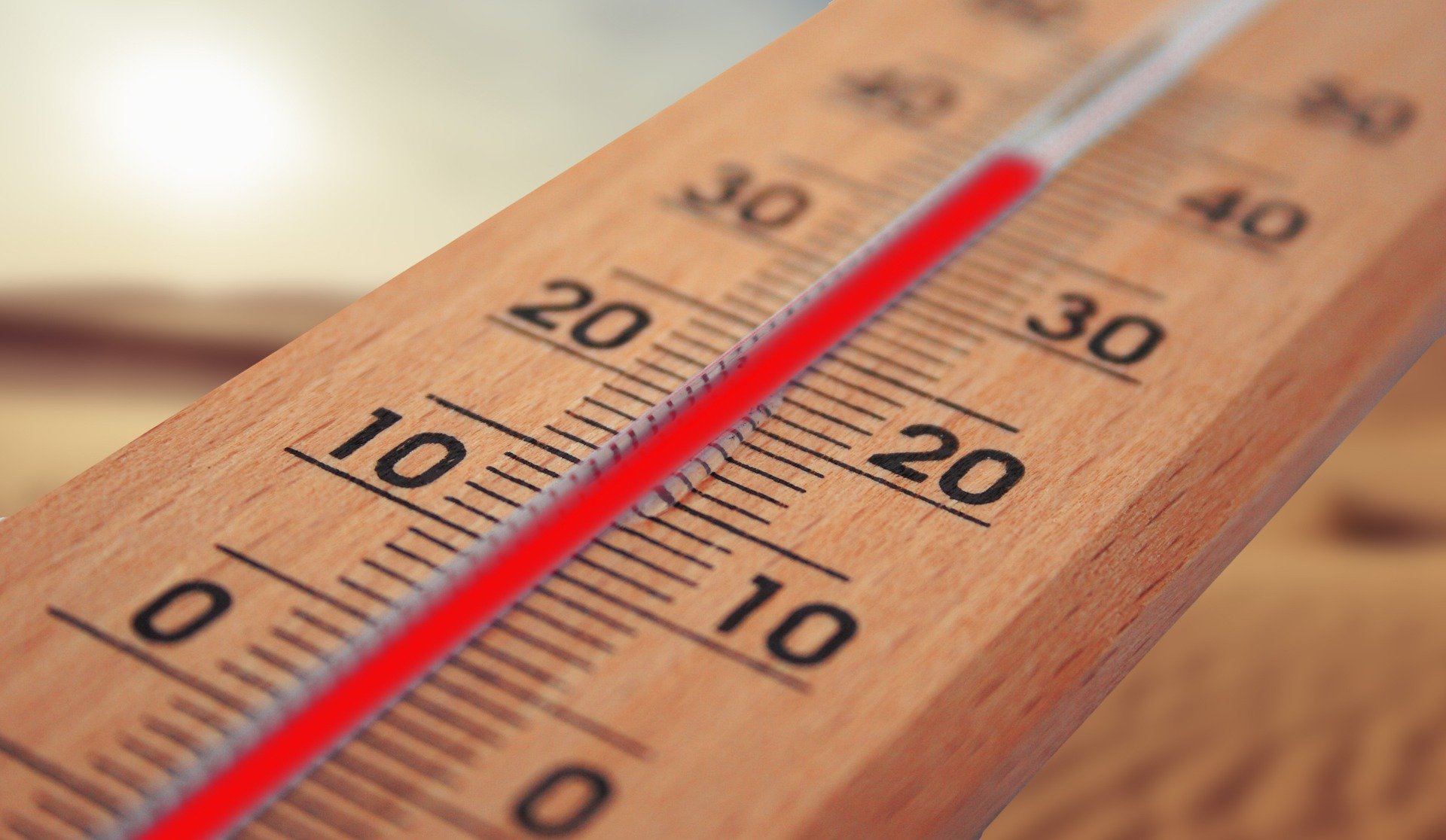
The present text analyzes, in the aftermath of the World Conference in Copenhagen, how much time remains to address the climate problem in line with the 2°C target – without a loss of prosperity and while maintaining prospects for growth – and which “jokers” (special measures or decisive actions) may already be necessary today. The text illustrates how narrow the remaining timeframe for achieving the target has become. The conclusions drawn here are even more striking than those derived from examining the development of the ecological footprint (see www.ecologicalfootprint.org), which also sends a clear message. However, since the ecological footprint excludes fossil energy sources, its implications are comparatively weaker.
https://www.fawn-ulm.de/wp-content/uploads/2021/05/thermometer-4294021_1920.jpg11161920FAW/nhttps://www.fawn-ulm.de/wp-content/uploads/2017/10/Logo_oben-300x121.pngFAW/n2014-07-11 12:37:002025-11-03 12:41:31Climate Policy and the 2°C Target
Cookie-Zustimmung verwalten
We use a few cookies to give you the best possible online experience.
Funktional
Always active
Die technische Speicherung oder der Zugang ist unbedingt erforderlich für den rechtmäßigen Zweck, die Nutzung eines bestimmten Dienstes zu ermöglichen, der vom Teilnehmer oder Nutzer ausdrücklich gewünscht wird, oder für den alleinigen Zweck, die Übertragung einer Nachricht über ein elektronisches Kommunikationsnetz durchzuführen.
Vorlieben
Die technische Speicherung oder der Zugriff ist für den rechtmäßigen Zweck der Speicherung von Präferenzen erforderlich, die nicht vom Abonnenten oder Benutzer angefordert wurden.
Statistiken
Die technische Speicherung oder der Zugriff, der ausschließlich zu statistischen Zwecken erfolgt.Die technische Speicherung oder der Zugriff, der ausschließlich zu anonymen statistischen Zwecken verwendet wird. Ohne eine Vorladung, die freiwillige Zustimmung deines Internetdienstanbieters oder zusätzliche Aufzeichnungen von Dritten können die zu diesem Zweck gespeicherten oder abgerufenen Informationen allein in der Regel nicht dazu verwendet werden, dich zu identifizieren.
Marketing
Die technische Speicherung oder der Zugriff ist erforderlich, um Nutzerprofile zu erstellen, um Werbung zu versenden oder um den Nutzer auf einer Website oder über mehrere Websites hinweg zu ähnlichen Marketingzwecken zu verfolgen.